
Hornet extermination
Order hornet extermination now at 724 123 321
Have you noticed dozens of hornets in your garden, heard their loud buzzing, and realized these unwelcome visitors have probably moved into your home? Whether their nest is under the roof, in the attic, or inside a tree hollow, such a situation can be very dangerous.
Forget DIY hornet extermination and call in our experts from DeraPro!
Occurrence of hornets in the Czech Republic
Although many different species of hornets live around the world, such as the Oriental, yellow-legged, or Asian giant hornet, you will not usually encounter these exotic species here. The only hornet species commonly found in our region is the European hornet. It lives in temperate areas of Europe and Asia, but can also be found in America, where it has been introduced.
The European hornet reaches a length of 18–35 millimeters, has large compound eyes, and two membranous wings with visible veins. In terms of coloration, its body features yellow, black-brown, and reddish tones. It is a predatory species that feeds its larvae various insects such as flies, moths, and dragonflies, as well as wasps and bees. Adult hornets, however, usually feed on sweet juices from flowers or fruit, tree sap, or even honey stolen from beehives.
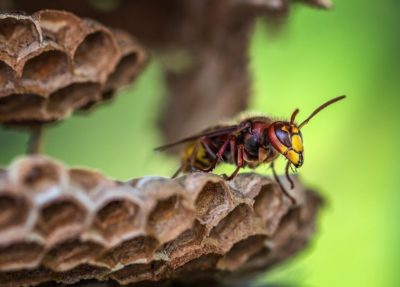 The European hornet is the largest European
representative of venomous social insects from the Vespidae family.
The European hornet is the largest European
representative of venomous social insects from the Vespidae family.
How is a hornet different from a wasp?
If you discover a nest near your home with dangerous buzzing, it is important to determine whether they are hornets or wasps. These species are very similar—both belong to the order Hymenoptera, both live in large colonies, and both build nests in tree hollows, attics, or under roofs. So how can you safely tell if hornets have settled in your home?
Common wasp (Vespula vulgaris)
- Reaches a maximum size of 1.5 centimeters.
- Has a typical black-and-yellow striped abdomen and similarly contrasting thorax.
- Feeds on nectar but also seeks out overripe fruit and sugary liquids.
- Most often builds nests in the ground, for example in abandoned burrows.
European hornet (Vespa crabro)
- Compared to wasps, it is larger and more robust.
- Has larger and more prominent mandibles than a wasp.
- Its coloration includes yellow, reddish, and black-brown shades.
- Hornet stings are much more painful than wasp stings.
- It can spray its venom up to a distance of 40 centimeters.
- It is active up to 22 hours a day and hunts even at night.
Why are hornets dangerous?
When people hear about hornets, most imagine dangerous insects that can attack at any time and fatally injure a person. These fears stem mainly from their size, loud buzzing, and venomous sting. However, if a person does not approach a hornet nest closer than two meters and avoids sudden movements, hornets are usually not aggressive and ignore people.
Have you found a hornet nest in your garden or attic? Call DeraPro experts immediately!
If a hornet lands on a person, it is usually just checking for a nearby food source and will soon fly away. However, if provoked, it may feel threatened and attack. Both workers and queens are equipped with a sting connected to a venom gland. A hornet sting is more painful than a common wasp sting, but it contains roughly 50 times less venom.
For most people, a hornet sting causes a normal skin reaction, including mild redness, unpleasant pain, and swelling at the site. More sensitive individuals—such as allergy sufferers, small children, the sick, and the elderly—may develop anaphylactic shock, and in some cases even death. For healthy individuals, stings to the tongue or throat can also be life-threatening.
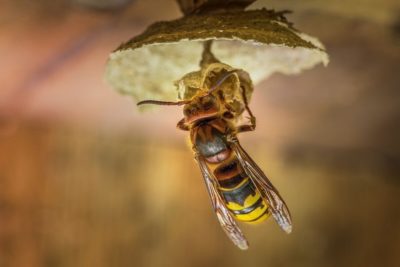 Under normal circumstances, hornets are not
aggressive and ignore people. However, if disturbed, they will not hesitate to attack immediately.
Under normal circumstances, hornets are not
aggressive and ignore people. However, if disturbed, they will not hesitate to attack immediately.
How can hornets be beneficial?
While most of us consider hornets extremely dangerous creatures that threaten our health, others see them as helpful allies whose presence in the garden is welcome. How is this possible? Although few people realize it, hornets consume large amounts of other insects, such as flies, moths, wasps, and spiders, helping to significantly reduce their numbers.
Why not eliminate hornets yourself?
Have you discovered a hornet nest near your home and are wondering how to get rid of hornets effectively? Unfortunately, many people rely on “proven” online advice and attempt to remove hornet nests on their own. However, no commonly available product—such as smoke bombs or universal insect sprays—actually works.
How does professional hornet extermination work?
Once you contact our team at DeraPro, we will arrange a specific appointment by phone and send an experienced specialist to your home. They will assess the situation professionally and propose the best solution to eliminate hornets once and for all. This is followed by the actual disinfestation process, sometimes incorrectly referred to as rodent control.
What can you expect from a professional intervention?
- We inform you about all necessary precautions.
- Hornet extermination is usually carried out early in the morning or late in the evening.
- We use specialized chemical products with a high concentration of active ingredients.
- We apply high-quality insecticidal spray directly into the nest.
- We can also install traps and bait on site.
- We always prioritize safety and use protective clothing.
For our experts, hornet extermination is usually a one-time procedure. The whole process typically takes 20–30 minutes. However, if the nest is in a hard-to-reach location or is larger, the process may take significantly longer.
What to do after the intervention?
People often ask whether any special rules need to be followed after the intervention. If everything goes as planned, no special measures are usually necessary. However, near the removed nest and in areas where hornets were most active, you may notice a larger number of dead individuals immediately after the intervention. Therefore, avoid walking barefoot in these areas and remove the dead hornets so that pets or small children do not come into contact with them.